
Coursework:
– Introduction to Digital Humanities (DH 8991, Fall 2025):

I developed a research project on climate fiction and eco-poetry in the Southern Cone, focusing on climate migration, solastalgia, and extractivism. I designed a workflow that combines corpus digitization and multilayer annotation in Recogito with semantic analysis in Voyant Tools, network visualization in Palladio, and interactive mapping in ArcGIS StoryMaps. Through this work, I learned to combine close reading with distant reading analysis, demonstrating how digital methods can expand the frontiers of literary criticism while simultaneously generating innovative maps of the narratives of climate migrants and their emotional geographies. The first assignment in this course was to digitize any media the students had in their possession that was not available online.
– DH Practicum: Data Design for Humanists (DH 7008, Spring 2026):

In the course “Data Design for Humanists” (DH 7008), I evolved from designing a single digital humanities project to creating a sustainable data ecosystem for my doctoral dissertation on climate fiction in the Southern Cone. I developed a research data management plan, a corpus, and a workflow for geospatial mapping, as well as risk mitigation strategies adapted to materials on the topics of solastalgia and climate migration. Using proposal and framework assignments, I analyzed research models in the study of Digital Humanities, improved my technical learning plan, and oriented the artifacts in my portfolio toward academic audiences and Digital Humanities centers, which helped me develop a scalable methodology that connects literary interpretation, data design, and long-term digital preservation.
On April 27, 2026, I will present a technical workshop aimed at digital humanists, showcasing an easy-to-use pipeline that combines named entity recognition (NER) with Voyant tools to analyze small English-language corpora on climate change. Participants will learn what NER is, extract entities from short texts, and interpret concordances and frequency visualizations to generate research questions connecting environmental narratives, people, and places. The session is structured as a short demonstration followed by an exercise in pairs and follows DHI best practices regarding workflows, vocabulary support, and post-workshop follow-up to continue experimentation.
Elective Courses:
– Content Analysis (MDST 7409, Fall 2022):

In the course “Content Analysis” (MDST 7409), I designed and executed a study on Chilean media coverage of the term “New Constitution” in the weeks leading up to the October 2019 insurrection. Based on an exploratory study that defined my research question, the corpus, the units of analysis, and the valence coding scheme, I refined my design into a systematic content analysis of 102 news stories from five major media outlets. Relying on speech act theory (coined by John L. Austin in 1962 and John Searle in 1969) to code intratextual patterns, I combined qualitative interpretation with quantitative coding to identify how different media outlets highlighted, downplayed, or “sidestepped” the emerging constitutional debate in Chile. The course also expanded my technical repertoire, including data processing and visualization in R, as well as the organization of code books, sampling plans, and reliability-oriented coding methods. This project, if published in an indexed journal, could serve as a methodological template for future digital humanities work on the intersection of media, environmental discourse, and political narratives in Latin America.
– Histories of Media Technologies (MDST 8001, Spring 2023):

In this course, I worked on a historiographical research project examining the “aesthetics of failure” in the websites of defunct American retail chains, examining early e-commerce websites as archival evidence of business failure and technological transition. Working with the Wayback Machine and media industry histories, I traced how outdated design, poor usability, and weak digital integration were indicative of broader organizational problems at chains such as Caldor, Ames, Circuit City, and RadioShack. The course equipped me to frame these observations through media history methods: curating archival corpus, formulating research questions, and situating my findings within academic studies on platform design, the retail “apocalypse,” and online accessibility for people with disabilities. The final essay and my set of questions articulated a conceptual model of “aesthetics of failure” that links visual design, user experience, and commercial decline, offering a transferable framework for analyzing digital interfaces as historical sources in the digital humanities and critical Internet studies.
– Additional complementary work:
- Website: Technologies for Linguistic Analysis (TECLing / POL)
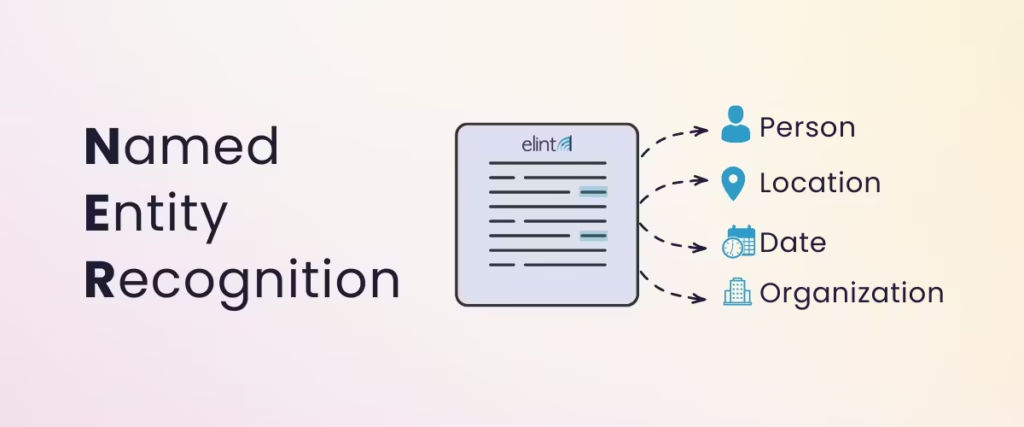
At Tecling, I helped develop and document POL, a supervised name entity recognition system for Spanish that makes use of FreeLing’s results to improve the classification of people, organizations, and places. This collaboration allowed me to improve my skills for preparing text corpora, designing context-based features, and evaluating against benchmark datasets such as CoNLL-2002, gaining hands-on experience with open-source NLP resources.
2. Journal article: Processing Natural Language (Journal SEPLN)

In my article published in the SEPLN journal, I presented methods for automatically classifying named entities in Spanish using hypernymic relationships and contextual cues, relying on FreeLing annotations and supervised learning. This work demonstrates my capacity to design an experimental pipeline, select training and evaluation corpora, and interpret trade-offs between precision and recall for linguistic and literary text analysis.
3. Conference papers (computational linguistics and DH-related):

I presented poster presentations at several conferences held in Chile and the United States, about the automatic classification of proper nouns using contextual cues and hypernymic relationships, focusing on Spanish-language news articles and domain-specific corpora. These projects allowed me to increase my experience with named entity recognition technologies (NER), and evaluation against benchmark standards, and communicating technical results to interdisciplinary audiences including linguists and computer scientists.
4. Conference paper: LASA 2023 – Nicanor Parra and mathematical functions

At this important conference, I presented the paper “‘Soliloquy of the Individual’ or the Individual Function,” where I explored the underlying mathematical functions and structures in Nicanor Parra’s anti-poetry. Despite being a predominantly literary work, this presentation served as a basis for my research in Digital Humanities, as it demonstrates how formal patterns (functions, series, limits) can be translated into annotatable categories for subsequent computational analysis of poetic structure.
5. Conference paper: RMMLA 2019 – New drug names and context

At the Rocky Mountain MLA conference (2019), I presented “Monitoring New Drug Names Based on the Detection of Contextual Cues in Spanish,” a project that used contextual cues to identify potential pharmaceutical neologisms in news corpora. This project allowed me to polish my skills in corpus building, rule-based pattern design, and the evaluation of retrieval and accuracy for emerging named entities, skills that now serve as the foundation for my NER work in the field of climate fiction.
6. Conference paper: Institute of Literature and Science of Language PUCV, 2018

In 2018, I presented “Automatic Classification of Entity Types Using Hyperonymy Relationships and Contextual Elements,” in which I extended the classification of entity types to include lexical relationships and local context. This research highlighted transparent, rule-based linguistic features, an approach that is well-suited to digital humanities projects, where interpretability and reproducibility are just as important as overall performance.
7. Conference paper: Automatized Processing of Texts and Corpora, Institute of Literature and Science of Language PUCV, 2016
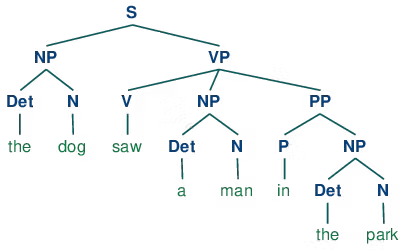
At the 2016 workshop on automated text processing, I presented “Automatic Classification of Proper Names Using Contextual Cues,” a pioneering experiment in context-based entity classification for Spanish. This work was the starting point of my ongoing journey in the field of named entity recognition (NER), corpus annotation, which later became the basis for my digital humanities (DH) research applied to climate fiction corpora.
8. Conference paper (dissertation chapter): Kentucky Foreign Language Conference (KFLC) 2022

At the Kentucky Foreign Language Conference (2022), I presented “Multisemiotic Artifacts, Rupture, and Counterculture: From Parra’s Anti-Poetry to Vaporwave,” in which I explored the continuities between mid-century editorial experimentation and contemporary digital aesthetics. This project sharpened my skills linking historical media forms with cultures born in the digital sphere, a perspective that guides my research on retro web aesthetics and the “aesthetics of failure” in retail.
9. Blog: retrocapitalism.com «The Nostalgia of the Collective Unconscious in Market Societies»

Retrocapitalism.com is my public blog on “capitalist nostalgia,” the archaeology of retail, and the cultural memory of late 20th-century capitalism, in which I combine short essays with archival images and screenshots from the Wayback Machine. Running this site has given me hands-on experience with WordPress publishing, image curation, basic SEO, and writing accessible commentary in English on topics related to my research for the MDST 8001 course on defunct retail websites.
– Extracurricular Technical Learning:
10. Co-facilitator at Second Workshop on the Teaching of Writing in the Foreign Language Classroom (UVA):

I co-facilitated the “Second Workshop on Teaching Writing in the Foreign Language Classroom” at the Institute of World Languages at the UVA, where I collaborated in the development and implementation of sessions on writing pedagogy and digital tools. This experience helped me reinforce my understanding of how to apply technical capabilities—such as learning management systems, collaborative editors, and basic analytics—to develop concrete teaching strategies for language classrooms, in line with the Digital Humanities (DH) values of transparency and accessibility.
– DH Events and Conferences:
11. Argentinean Society of Digital Humanities (Buenos Aires, March 2026):

At the Argentine Society for Digital Humanities (Universidad del Salvador, March 2026), I presented “Literary Cartographies of the Anthropocene,” in which I described the combination of close reading and digital humanities methods (Palladio, Voyant Tools, POL, FreeLing, ArcGIS StoryMaps) used in my doctoral thesis to study solastalgia, eco-insile, and eco-exile in Chilean and Argentine 21st Century literature and poetry. The presentation emphasizes the importance of affective cartographies of the Southern Cone, connecting extractivism, precarious labor, and “retrocapitalism” through a textual analysis at multiple scales. For my doctoral dissertation, I intend to share to the community a high-impact DH achievement: a GIS StoryMaps visualization of the Southern Cone’s migration and environmental patterns found in the novels and poetry selected for my research. This project combines data on migration with cartographic tools to create a spatial narrative of the region’s migration and environmental crises.
12. GIS Story Maps project: The evolution of the Chilean-Argentinean Borders During the Colonial Period (2021)

This ArcGIS StoryMaps project examines how colonial maps “invented” Chile by mapping the Andes and Copiapó as strategic frontiers between the 16th and 18th centuries. By combining cartographic archives with theories of space (Henri Lefebvre), coloniality (Ricardo Padrón, Edmundo O’Gorman), and Chilean border history (Alejandra Vega, Guillermo Lagos Carmona), it illustrates how a succession of maps redefined national sovereignty, urban planning, and economic control. Technically, the project demonstrates skills in historical map research, geo-referencing and map overlay in ArcGIS Online, basic spatial analysis, and narrative design in StoryMaps (sectioning, legends, multimedia integration). From an academic perspective, the project is an example of building a curated cartographic corpus, conducting a detailed visual and textual analysis of the maps, and conveying the findings through an accessible, bilingual digital narrative. This methodology can be implemented in a wide range of teaching contexts, including literary cartography, location-based learning activities, and collaborations in the field of Digital Humanities, utilizing maps to teach Latin American literature and colonial history.
13. Original «stripped down» music remixes:

Using a “stripped down” mixing technique, I have created original mixes of The Beatles’ “Here Comes the Sun” and other popular songs by selectively silencing orchestral layers, guitars, and background elements to emphasize the lead vocals and harmonies. I mixed these versions using Pro Tools, Adobe Audition, and Audacity, working with multitrack sessions, EQ, compression, and stereo imaging to rebalance the arrangements. This audio project demonstrates valuable digital humanities skills: critical audio listening, multimodal editing, and proficiency with professional software and file workflows, all of which are transferable to podcast production, sound-designed digital exhibitions, and academic courses that integrate music into innovative and public-facing projects.
Original Stripped Down Remixes:
– «A Day in the Life» (1967) by The Beatles.
– «Here Comes the Sun» (1969) by The Beatles.
– «Don’t Speak» (1996) by No Doubt.
14. Retrocapitalist Artifacts

For my retro-capitalist video artifacts, I compiled short clips of news shows, shopping malls, and shopping scenes from the 1980s to the 2000s. Then I re-edited them into new sequences accompanied by vaporwave tracks such as “Black Friday Madness” (2013) by Luxury Elite. Using Pro Tools, Adobe Audition, and Audacity, I remixed the audio; in Final Cut Pro and VEGAS Pro, I edited sequences to create a simulacrum of a music video that never existed. These retrocapitalist artifacts demonstrate media literacy skills aligned with digital humanities, such as multimodal editing, critical media remixing, and copyright-conscious reuse. They are relevant to teaching media literacy, creating audiovisual exhibitions, and designing experimental assignments in digital cultural studies.
Some retrocapitalist artifacts are:
– «Donald wants to rule the world.» (I didn´t add the uncanny valley effect to the video)
– «70’s muzak effects on 2018’s consumers»
– «Black Friday Madness», vaporwave music by Luxury Elite.
– [Tokio at night footage 1987] Vaporwave music by Dan Mason ダン·メイソン
– DH Research Assistant Work:
15. Tecling Spanish Language Network, 2014–2020:

As a research assistant in the Tecling group, I worked on Spanish language technology projects, such as POL, a tool that improves the automatic detection of names of people, organizations, and places. I helped to create text datasets, review and correct automatic annotations, and compare our results with other tools such as FreeLing. I also collaborated on designing computational linguistics experiments and writing clear documentation for humanities researchers so they could understand and reuse these tools. This experience provided me with a solid technical foundation for further projects in digital humanities, including training models, extracting patterns from texts, and sharing web demos with research communities.